
I wrote this article after I had been an EV owner for only six months. I saw the need for a few insights into how EVs work and thought I would pass on what I had learned.
The original intension was that I would make a youtube video and this was the script. When I searched for EV beginners I found there were lots so I abandoned the idea. But I still have the text and here it is.
I bought my Fiat 500e new in June 2025. I've got to take it in for it's first service in another year time.
Hi I'm Dave I'm here to share some of my thoughts and what I have learned about being an owner and driver of an electric vehicle (EV).
My Fiat 500e.
I bought my Fiat at the beginning of June 2025. I have to take it in to the dealership for its first service June 2027.
Prior to purchase and when I got it home my concerns were range and Charging.
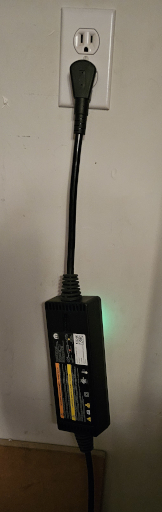
Level 1 charger plugged in.
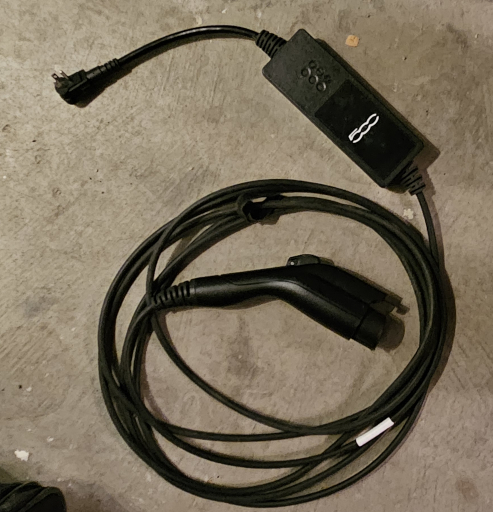
Level 1 charger with cable
and J1772 connector.
Your vehicle probably comes with a level 1 charger. To fully charge your car with a level 1 charger will probably take more than 24 hours. If your battery gets down to 0% you probably won't be in your garage. I live in Calgary Alberta so my local auto-club is the AMA, they have a road side service where they can give a minimal charge to a stranded EV. So check their services and join your local auto-club. You can't walk down the road to the nearest charger and get a jerry-can full of electricity.
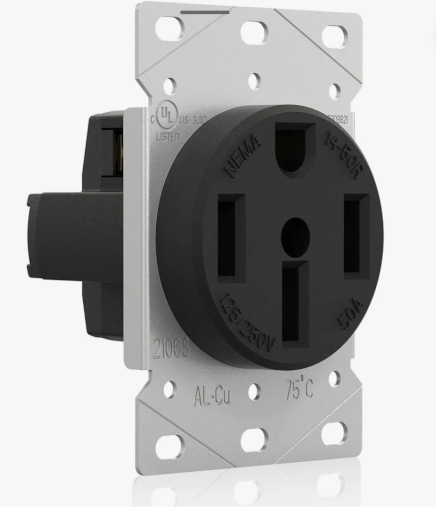
If you want faster charging you can get a level 2 charger installed. A level 2 charger has to be installed by a qualified electrician. If you are a qualified electrician you can install it yourself but the rest of us need to hire someone. You can get them hard wired or that can plug into a 14-50R outlet the same sort of an outlet you have at the back of your cooking stove and clothes drier.
Level 2 allow charging over 6 times faster than your level 1 charger. The actual speed depends on the specifications of your equipment. The current your outlet can supply and the current required by your charger. You will also probably require your breaker box to be no less than 200 Amp.
Canadian electrical codes say you can't sustain the breaker current by more than 80%. That means on a fifteen Amp circuit, you can't sustain more than 12 amps. A 6-15R receptacle can't have a breaker higher than 15 amps. It's the same with a 14-50R receptacle with a 50 Amp breaker you can only go up to 40 amps charging. A level 2 charger can be hard wired and if it is it can use a 60 Amp breaker and allow you 48 amps for charging. So maximum charging for level 1 is theoretically 1.32 kW. For a plug in level 2 maximum charging is theoretically 8.8 kW and for a hard wired level 2 the theoretically maximum is 10.56 kW. A level 2 plug-in is 6.6 times faster than level 1. And a hard wired level 2 is 8 times faster. Level 3 or DC fast charges are completely different the level 1&2 AC supply has to be converted to high voltage DC by your vehicles battery control whereas the DC charger supplies the battery directly. To operate level 3 charges you are probably better off using an app on your phone. The app I use is ChargeHub, there are lots of others, check Google play or Apple store. If you download one of the apps you should browse and see what is available. All charging stations are marked on the apps map. The info is live it will tell you if a particular charging station is in use or not. If there are any special instructions for using a charger your app will explain.
Now the comparative cost. You will see from the app some charges charge by the kWh and some charge by time! Strange you think are gas stations about to start charging by the length of time it takes you to fill up.
The fact is this that charging is not a straight line process the higher the charge level in your battery the slower it is to push kWh s into your battery. So the reasoning behind is they want the charger available for as many customers as possible. If they charge by time they discourage customers from charging over 80% and also discourage customers heading to a restaurant while there vehicles charge. BC Hydro charge by the kWh. Once your vehicle is charged they give you 5 minutes to disconnect and then charge $0.40 per minute. Because of the fact that charging slows down as the battery level goes up most experts advise that you only charge to 80%. It won't hurt your battery if you take it up to 100% and if you are planning a long trip it may be worth your while to start off with a full battery. I usually charge up to 80% if I am only expecting to be driving around town.
The cost of charging at home is fairly easy to calculate. Examine your electricity bill and it will tell you the cost per kWh. This is NOT the cost of electricity. Add on the administration fee, the distribution fee, the transmission fee and the city access fee. Take the total amount the utility company charges you including taxes and divide it by the number of kWh this is the cost of electricity.
At home I am paying about $0.31 per kWh and the average I have payed for level 3 charging is $0.37.
Now lets talk about range. The dashboard display in your vehicle will give you an estimate of the current range you need to consider where the next charging availability is. Google maps will tell you how far your target is also consider whether you need to get there and back. I haven't done it yet but I have planned a trip from here, Calgary, to Tofino and there is nowhere on the trip that anywhere near exceeds my vehicles range, and I only have a 42 kWh battery. The only thing to possibly watch out for is you may sometimes need to extend your range by charging to 100% instead of 80%.
No engine means no oil changes, no coolant, no exhaust. With just an electric motor and only 1 gear you don't need a gear shift just buttons on the dashboard PRND Your brakes are hydraulic so brake fluid needs to be checked how often check your manual. Same with wind shield washer fluid.
A word about regenerative breaking. Depending on your driving style you may hardly ever use your physical brakes, this is good because your brake pads will last much longer. However grit and road gunge especially in winter may reduce the efficiency of them. You need to make sure they are cleaned and inspected maybe in spring when you put on your summer tires. Regenerative breaking is an energy saving device performed by your vehicle. It uses the electric motor in reverse to generate electricity to put back in your battery.